

Claude Text Watermarking Is Coming to All Operators: What the SynthID-Text Detection API Means for Your Pipeline
Future Claude models will embed a SynthID-Text watermark globally, with no opt-out. A detection API is coming. Operators running content-review or compliance pipelines need to understand what the watermark proves — and what pipeline modifications can silently degrade it.
Archive item produced with AI assistance from the cited source and published without individual review. Editor of record: Joe Werner.
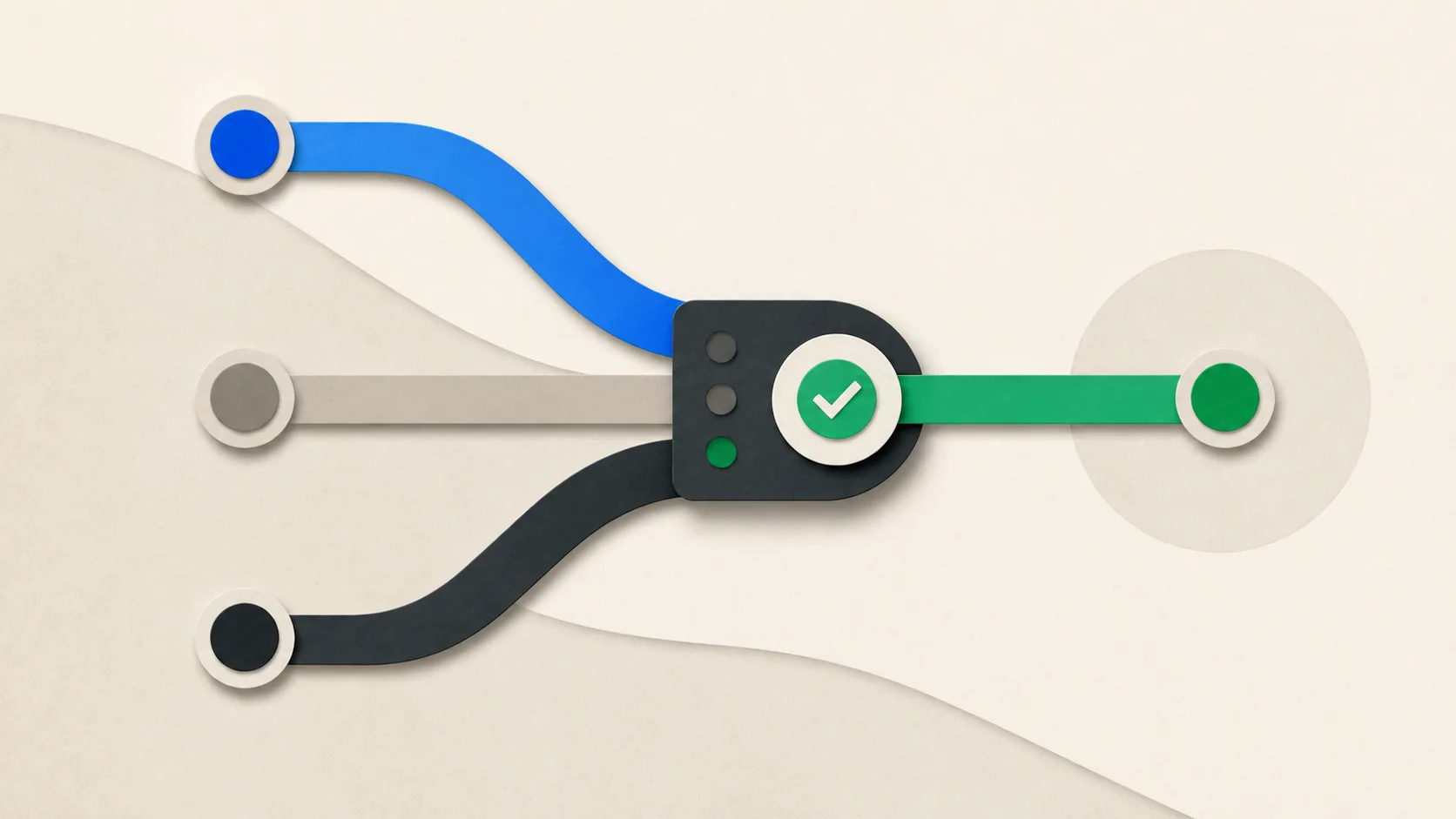
Anthropic published the technical and policy details of how Claude's text watermark works on August 14. The short version: future Claude models will use a variant of Google DeepMind's SynthID-Text method to embed a probabilistic watermark in every generation. No extra tokens. No hidden characters. No user or org identification. But there are real consequences for operators who build content-review, compliance, or grounding-verification workflows on top of Claude's output.
How the watermark works at the token level
Claude generates one token at a time by sampling from a probability distribution over candidates. When multiple tokens would be roughly equivalent in meaning ("overcast" vs "grey", "function" vs "method"), Claude normally resolves the tie with a standard random number. With watermarking on, that tie-breaking randomness is replaced with a keyed pseudorandom function: the key combined with a small context window of prior tokens determines which of the equivalent candidates gets picked.
The result: the word sequence carries a statistically detectable pattern only Anthropic (with the key) can verify. It does not change the expected quality of output. Google DeepMind validated this on live Gemini traffic and found no statistically significant difference in human thumbs-up/thumbs-down ratings.
Two output types are intentionally sparser:
- Code: variables, function names, syntax tokens have one right answer most of the time. The watermark only applies where there is genuine lexical choice — comments, string literals with multiple valid phrasings. The functional code path itself is untouched.
- Factual recall: once the model is completing "Isaac Newton's most famous work was called Principia", there is no equivalent alternative. No nudge applied.
Short samples — a few sentences — carry too little signal for confident detection. Detection confidence rises with length.
What Anthropic's detection API will and won't be able to tell you
Anthropic announced that a watermark detection API is in development. The API will answer a single probabilistic question: what is the likelihood this text was partly generated by Claude? That is all.
It cannot:
- Confirm the text is human-written (absence of watermark is not proof of human authorship)
- Detect whether another AI was involved (different provider, different key, possibly a different algorithm)
- Identify the user, organization, or conversation that produced the output
- Definitively prove Claude involvement on short text, heavily edited text, or proofreaded-only text
This distinction matters for operators considering the detection API as a compliance or moderation gate. A positive detection signal means Claude was probably involved at some point. It does not tell you whether the human who submitted the content rewrote it 80% before sending, or whether Claude's involvement was limited to grammar corrections.
Where the watermark does not survive
Anthropic is explicit that the watermark degrades under editing pressure:
- Light editing probably does not remove it
- Complete rewrite (every word replaced) removes it, at which point Anthropic's position is that the text can no longer meaningfully be called AI-generated
Operators who run AI-assisted content pipelines where humans heavily revise outputs should not assume a watermark-absent result means human-only authorship.
The multi-provider picture: who is already shipping this
Anthropic is implementing watermarking to comply with the EU AI Act and the EU Code of Practice on Transparency of AI-Generated Content (July 2026, ~190 signatories). The relevant regulatory requirement took effect August 2, 2026.
The providers that have already shipped or announced text watermarking:
| Provider | Watermark method | Status |
|---|---|---|
| Google (Gemini) | SynthID-Text (same technique) | Live in production |
| Anthropic (Claude) | SynthID-Text variant | Deploying on future models |
| OpenAI | Not publicly announced for text | Announced C2PA for images |
| DeepSeek | No announcement | — |
| Qwen/Alibaba | No announcement | — |
Claude and Gemini will share the same watermarking approach but use different keys — so Anthropic's detection API cannot detect Gemini output and vice versa.
For files (images, SVGs): Claude already attaches C2PA content credentials to supported file types. This is separate from text watermarking and uses a different detection path.
What changes for operators on the Anthropic API
Pricing and throughput: Nothing changes. No extra tokens are generated. Anthropic states the computational overhead is negligible and the model is the same price to serve.
Model coverage: The watermark applies to future Claude models. Older models (released before August 2, 2026) have a regulatory transition period and will get watermarking rolled out over the coming months. There is currently no way to opt out — Anthropic applies it globally because they do not yet have a reliable region-scoping mechanism.
Responses API format and streaming: The watermark lives in the probability sampling step, not in post-processing. It is transparent to the API surface — the token stream, the content block, and the stop_reason are all unchanged.
Routing via intermediary gateways: If you route Claude traffic through a proxy that buffers or modifies response tokens (e.g., transforming newlines, stripping BOM characters, re-encoding output), you may unknowingly degrade the watermark in the output before it reaches your downstream consumer. This is likely low risk for most HTTP-passthrough setups but worth auditing for any pipeline that modifies text at the token or character level.
Before the detection API lands: what to audit now
Operators who will eventually want to use the watermark detection API for compliance or content-review workflows should do three things now:
-
Identify which pipelines output Claude-generated text to humans: content-generation, customer-facing chatbots, document drafting, translation. These are candidates for watermark-based post-hoc audit once the detection API is available.
-
Decide what a "watermark detected" signal means in your workflow: it is a probabilistic signal, not a binary proof. Build in thresholds and human review steps now rather than retrofitting them when the API is live.
-
Check whether your pipeline post-processes Claude output at the character level: character normalization, whitespace normalization, or encoding transforms could affect watermark integrity. Test this against Anthropic's detection API once it ships.
What changes for TheRouter users
TheRouter passes the Anthropic API token stream through without modification. No changes are needed on the routing side. The watermark is transparent to the HTTP layer.
When Anthropic's detection API ships, TheRouter users in regulated industries (EU, government, financial services) will be able to integrate a detection step downstream of the routing layer — calling the detection API against sampled output to verify AI involvement for audit trails. The routing policy itself does not need to change for this.

Claude API HIPAA Is Now Self-Serve: What the July 14 BAA Change Means for Health-Adjacent Operators
Anthropic made HIPAA configuration self-serve on July 14, 2026 — eligible Enterprise and API org admins can now accept the BAA and enable HIPAA in one flow, no sales cycle required. Here is what this changes for operators routing health-adjacent workloads.

Fable 5.1 Breaks Two Operator Assumptions: `tool_choice` Force-Calls and Thinking Block Reuse
Fable 5.1 breaks two patterns operators rely on: `tool_choice: any` and `tool_choice: tool` now return 400, and thinking blocks are version-gated with prefix-mismatch enforcement for new accounts. Migrate both before routing production traffic.

Claude Access Transparency Compliance API: What Enterprise Operators Must Know Before the First cmek_preserve Event Arrives
Anthropic expanded Claude Access Transparency docs with cmek_preserve reason codes and a filter example. Enterprise operators routing API traffic through Claude now have a formal audit channel — wire it into SIEM pipelines before the first preservation event lands.